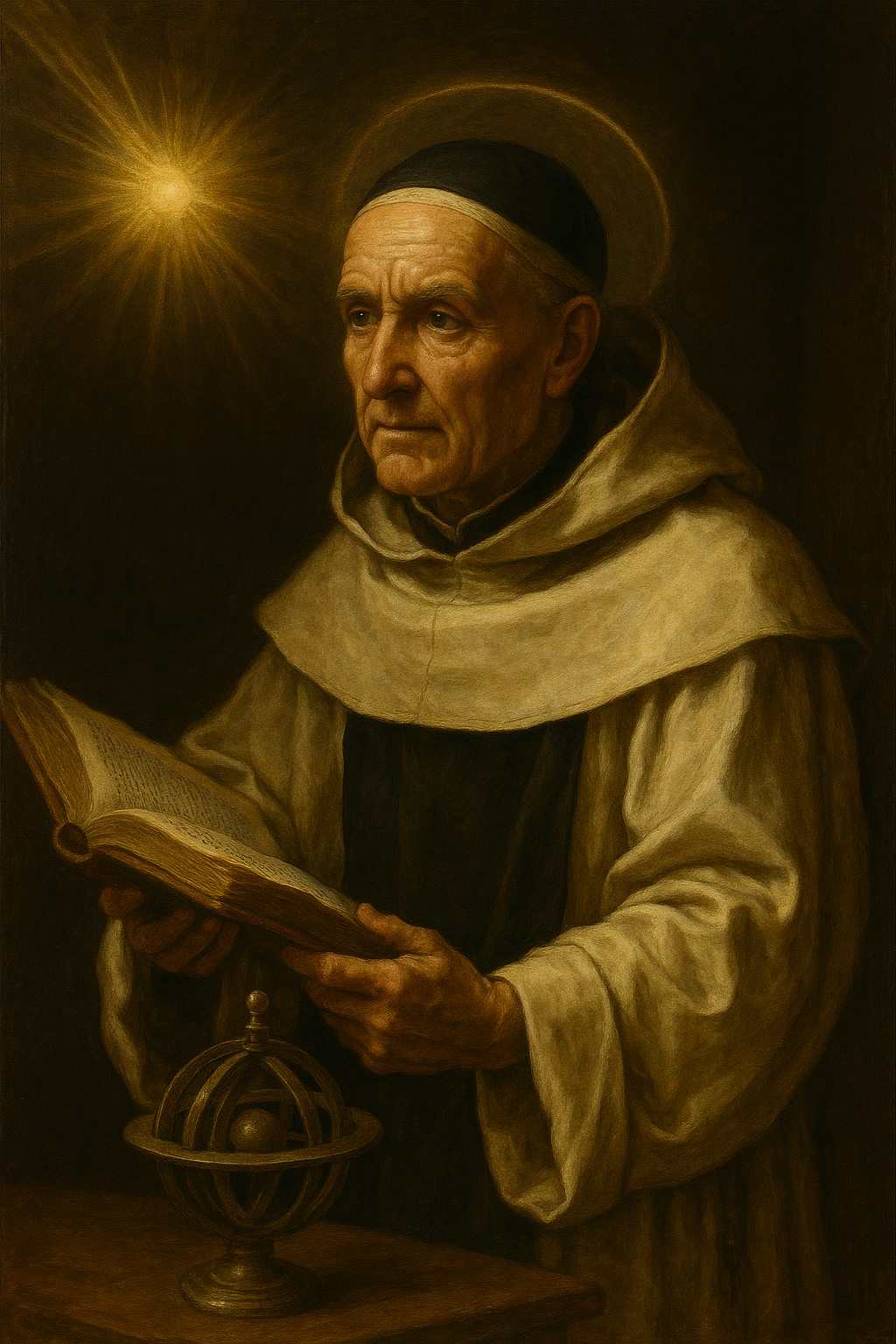

Saint Albert the Great, also known as Albertus Magnus, shines as one of the most brilliant lights of the Middle Ages. A Dominican friar, bishop, and teacher of Saint Thomas Aquinas, he earned the title Doctor Universalis—the Universal Doctor—for his vast knowledge and holiness. Through his life and works, Saint Albert showed that true wisdom unites faith and reason, leading both the mind and heart toward God.
Early Life and Religious Vocation
Albert was born around 1200 in Lauingen, Germany, to a noble family. From a young age, he displayed an insatiable curiosity and a deep reverence for creation. His studies led him to the University of Padua, where he encountered the Order of Preachers (Dominicans). Moved by their intellectual rigor and spiritual discipline, he joined the order despite his family’s opposition.
As a Dominican friar, Albert immersed himself in study and prayer. He mastered theology, philosophy, and the natural sciences, believing that all truth reflects the wisdom of God. His devotion to both learning and holiness soon made him one of the most respected scholars in Christendom.
To learn more about the Dominican Order, visit the Order of Preachers Official Site.
Teacher of Thomas Aquinas and Scholar of Creation
Saint Albert’s reputation as a teacher spread quickly. In Cologne and Paris, he trained some of the brightest minds of his era—including Saint Thomas Aquinas, who would become the greatest theologian of the Church. Albert immediately recognized Thomas’s brilliance and defended him from those who mocked his quiet nature, calling him “the Dumb Ox.” Albert famously predicted, “This ox will one day fill the world with his bellowing.”
Albert’s own scholarship was vast. He studied and wrote on nearly every known subject—Scripture, philosophy, astronomy, physics, botany, zoology, and even chemistry. He believed that the study of nature revealed the Creator’s design and that scientific inquiry, when rightly ordered, led the soul closer to God.
His integration of Aristotle’s philosophy with Christian theology laid the foundation for centuries of Catholic intellectual thought.
A Bishop and Shepherd of Souls
In 1260, Albert was appointed Bishop of Regensburg. Though reluctant to accept the position, he obeyed out of humility and love for the Church. As bishop, he lived simply, refusing luxuries and focusing on reforming clergy and serving the poor.
After two years, he resigned and returned to teaching and preaching. Even in his later years, Albert traveled widely across Europe, resolving disputes and promoting peace within the Church. His wisdom and holiness earned him admiration from both scholars and common folk.
For more about his episcopal ministry, visit Catholic Online – St. Albert the Great.
Holiness, Humility, and Final Years
Despite his immense intellect, Saint Albert remained humble. He never sought fame or recognition, considering his learning a means to glorify God. He often reminded his students that knowledge without charity is empty.
In his later years, Albert’s memory began to fail, yet his faith and devotion never wavered. He spent his final days in prayer and contemplation at the Dominican priory in Cologne, where he died on November 15, 1280.
Pope Pius XI canonized him in 1931 and declared him a Doctor of the Church in 1932, honoring his contributions to theology, philosophy, and natural science. He was also named the patron saint of scientists and philosophers.
Legacy of Saint Albert the Great
Saint Albert the Great’s legacy continues to inspire both theologians and scientists. He demonstrated that the pursuit of knowledge need not contradict faith, for both come from the same divine source. His life proves that holiness and intellect can harmoniously coexist when ordered toward truth and charity.
His feast day, celebrated on November 15, invites all Christians to seek wisdom that leads to God. Whether in science, study, or prayer, Saint Albert teaches that every discovery in creation is an invitation to adore the Creator.
Conclusion
Saint Albert the Great, Bishop, Confessor, and Doctor, stands as a bridge between faith and reason, science and theology. His deep intellect and even deeper humility made him a true servant of truth.
May his intercession inspire us to love God with both heart and mind and to see in every created thing the reflection of divine wisdom.
Related Links: