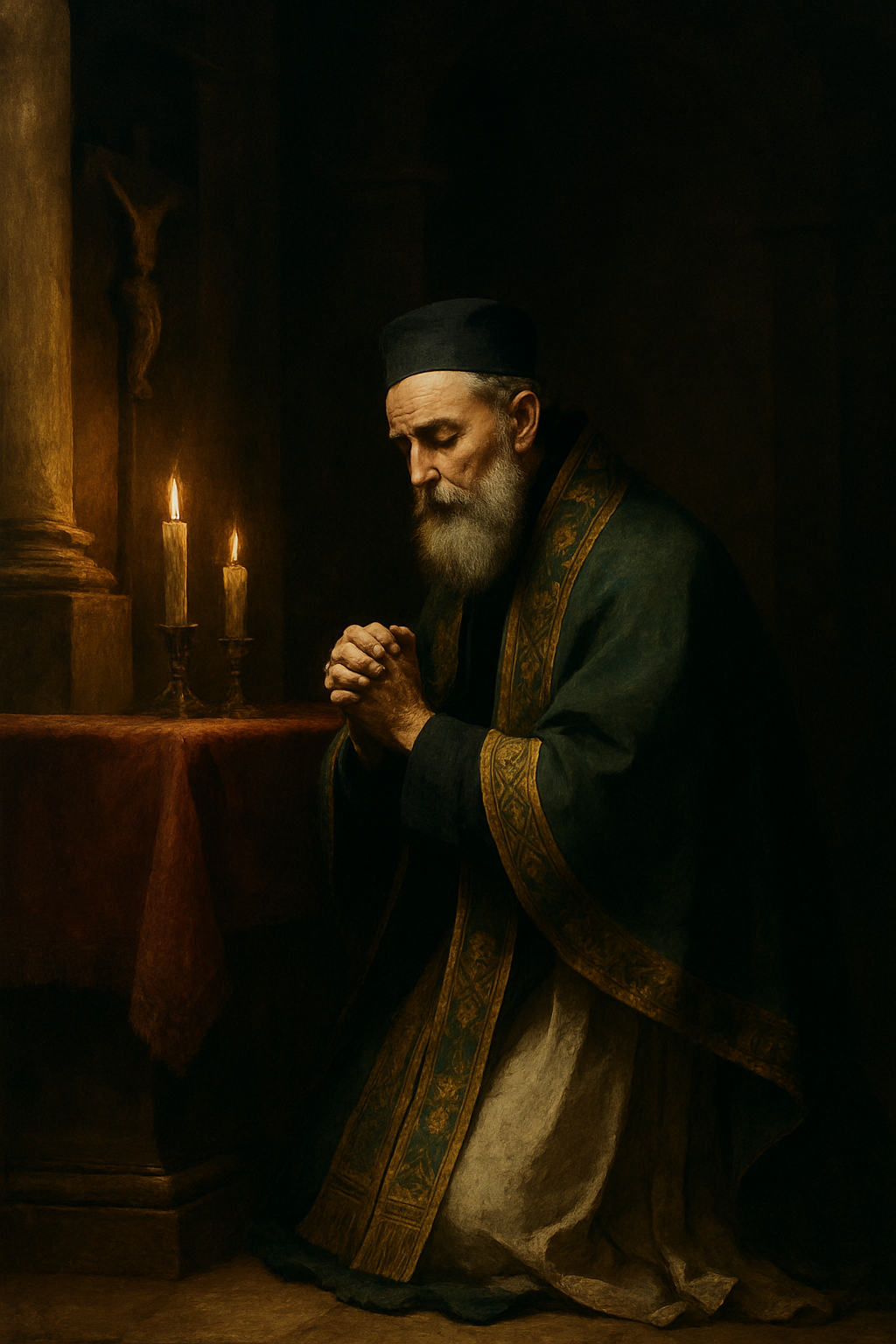

Saint Josaphat, Bishop and Martyr, stands as a radiant witness to the power of unity in Christ. His life was marked by tireless efforts to reconcile divided Christians and bring peace to a Church torn by schism. Through humility, courage, and unshakable love for truth, he offered his life as a sacrifice for unity, earning the title “Martyr for Christian Unity.”
Early Life and Religious Vocation
Saint Josaphat was born around 1580 in Volodymyr, Ukraine, into a family belonging to the Ruthenian Orthodox Church, which had separated from Rome. From childhood, he showed a deep attraction to prayer and purity of heart. Drawn to the Catholic faith, he entered the Monastery of the Holy Trinity in Vilnius, where he joined the Order of Saint Basil the Great.
His intense devotion and love for the Eucharist soon made him known as a man of God. When the Union of Brest (1596) brought many Eastern Christians back into communion with Rome, Josaphat became one of its most ardent defenders, seeing unity with the Holy See as essential to the Church’s mission.
For more on his early life, visit Wikipedia – Saint Josaphat Kuntsevych.
Bishop of Unity and Reform
Ordained a priest, Josaphat was soon appointed Archbishop of Polotsk, where he faced the difficult task of reconciling divided communities. He preached tirelessly about unity with Rome, reform of clerical life, and fidelity to Catholic teaching while preserving the rich Eastern liturgical tradition.
He often said,
“Let us be united in faith and love, for we have one Lord, one faith, one baptism.”
His deep compassion and personal holiness won many hearts, though his work also provoked fierce opposition. Still, he continued to rebuild the Church through teaching, prayer, and example, insisting that unity did not mean uniformity but communion in truth.
Conflict and Persecution
Josaphat’s efforts for unity were met with increasing hostility. Many opposed the reunion with Rome, viewing it as a betrayal of their heritage. False accusations spread against him, and unrest grew in his diocese.
Yet the bishop remained steadfast. He prayed constantly for his persecutors and continued to preach reconciliation. His gentleness disarmed many, but some remained hardened against him. He knew the dangers but often said,
“I am ready to die for the holy union, for the supremacy of the Roman Pontiff.”
For more about his episcopal work and writings, see Catholic.org – Saint Josaphat.
Martyrdom for the Faith
In 1623, while visiting Vitebsk, a mob incited by enemies of the Church attacked his residence. Refusing to flee, Saint Josaphat faced his assailants peacefully, forgiving them even as they struck him. He was beaten, shot, and finally thrown into a river—his blood sealing his testimony of unity in Christ.
His death shocked both Catholics and Orthodox. In the years following, many who had opposed him returned to communion with Rome, moved by the power of his example and the miracle of his forgiveness.
Canonization and Legacy
Pope Urban VIII beatified Saint Josaphat in 1643, and Pope Pius IX canonized him in 1867. His relics were later transferred to St. Peter’s Basilica in Rome, where they remain a sign of his deep union with the universal Church.
Saint Josaphat’s martyrdom bore lasting fruit. His life continues to inspire efforts toward unity among Christians, reminding the faithful that true peace is built on fidelity to truth and love.
His feast is celebrated on November 12.
Conclusion
Saint Josaphat, Bishop and Martyr, reminds us that unity in Christ requires sacrifice, patience, and unwavering faith. His example invites every Christian to pray for the healing of divisions and to live in the spirit of love that unites heaven and earth.
“Lord, make us one, as You and the Father are one.”
May Saint Josaphat’s intercession strengthen our commitment to truth and unity within the Church of Christ.